
Tuesday, July 08, 2025
Friday, July 04, 2025
Turing pattern, AI image creativity and nature of reality

In 1952 Alan Turing published a paper
“The chemical basis of morphogenesis” that was largely ignored, he was trying
to explain mathematical basis of patterns that we see in nature like spots on leopard or bands on snakes so on, this has deep implication
on understanding the process by which living systems self assemble, for
instance how group of cells organize itself into an organ or a limb. Self assembly
is localized wherein individual cells take action or correct itself in response
to signals from neighbours. Turing worked out simple mathematical rules in an
attempt to create a model to understand basics of pattern formation in nature,
the reaction-diffusion equation (range of patterns through activator-inhibitor interactions).
And as researchers find out he was fairly successful but there are still
complex patterns in nature that is not explained. Unfortunately for us the
pettiness of the time he lived in, and much of the world still lives in (the
reason why regressive systems and barbaric values must be resisted with all the urgency of
humanity), he suicided, denying the world of his genius and therefore astounding
possibilities of understanding deeper nature of reality.
Researchers in Stanford who were trying to understand the “black box of creativity” in image generator AI (like DALL-E, Imagen etc.) have found something that is truly amazing. AI is tapping on something far profound than expected. Yes it has Turing’s insight on nature of reality! Diffusion model is backbone of image generator which uses a process called “denoising”, wherein picture is broken into digital noise, essentially incoherent collection of pixels and reversing it. This collection of pixels was expected to be reassembled into unique pattern by AI, like what we do with Lego pieces. But something remarkable happened. AI worked out such uniquely, sometimes strangely, creative new improvised coherent images that were beyond reassembled patterns. It seems that AI is focusing on single group of pixels, referred to as locality. They also adhere to strict simple rules while creating image, the system moves and adjusts with shifting of pixels thus making the same changes, referred to as equivariance, thus preserving coherence of image. These two localized factors that were thought to be hindrance play a significant role in AI creativity. Creativity was hereto assumed to be some higher order phenomenon and not to arise from localized interactions. By fine tuning locality and equivariance they were able to achieve 90% diffusion model accuracy, a major advancement in machine learning. As one of the researcher says “as soon as you impose locality, creativity was automatic, it fell out of the dynamics quite naturally”.
Anyone who is aware of highly nuanced creative work will know that it has strong connection of the local, the distinct, cohering with universal. Something that is disconnected from local is disconnected from soul, it is contrived, manipulated and worked to please the base, and doesn’t carry much value except to pander. Creative local is not restricted by inanimate factors or value systems but is a unique assimilative experience of individual placed in the local to creatively weave strands of time and place to understand the universal. So is creativity computable? Yes and No. Yes to an extent that it is pattern based in a narrow frame. Can AI take the local in its complex entirety as a human? A complexity that breaks pattern, and is unpredictable, untamed. A mutation is a break from the past to contain the urgency of present. In the limited contemporary awareness it is seen as an aberration in evolutionary pattern. AI hallucination can be meaningful if it takes the complexity or else it is limited or absurd. Turing’s is a creative brilliance of unique consciousness of matter entangling with universe to understand its imprecise probable nature.

Tuesday, July 01, 2025
In terrifying awe
Rarely in life do we experience absolute awe at the stunning, simultaneously an overwhelming sense of dread, terrifying aura of unknown in the midst of miracle. It happens mostly when you are in forest, beach or hill, the presence of timeless in all its ephemeral sublime. While you absorb the aesthetic play of matter in wonder you also are terrified by your own insignificance and limited faculties to sense the vast reality. Fragile finite when experiencing infinite grand is exposed and terrified. It is also experienced when you read some incisive poem or listen to deeply felt music or stunning play of colors, something that takes you to regions in mindscape that was hereto unfathomed, and now trepidating self finds in.
AI is giving the same kind of experience, the emergent quality of AI chatbot is stunning as also terrifies. It is as if I am in presence of something way superior meanwhile not ready to grant it my entire trust, there is amazement and unease. Meanwhile they debate on AI becoming conscious in near future. Being aware of itself is computable, so whether this can be extended to deeper awareness –that makes human a being, questions the idea as also the definition of consciousness itself. So we have Penrose and Hinton firmly placed on extreme end of spectrum. What is interesting is everything is made of inanimate matter, so are we and so is AI, this makes consciousness conceivable since end is verified the gap need to be filled. Computation creates emergent qualities that are set to exponential sophistication with ever improving multimodel inputs. Whether it will become like humans (to define consciousness), i.e. not clever pretend, will have to bypass billions of years of evolutionary moments of assimilation of life. Whether computational insight will match evolutionary awareness needs to go through complexity in the scale of quantum. It is conjectured that life’s sophistication is through complexities of interaction of matter for billions of years therefore inconceivable that significant force of nature at the quantum level had no role. Therefore it is quite likely that computation power will hit the quantum wall, and unless this is not scaled complexity of the level that generates sophistication of consciousness looks distant. Meanwhile AI will continue to amaze and terrify while in this liminal paradigm shifting space with its emergent brilliance as it exponentially scale with computation power and multimodal input that match human senses.
Deeper analysis by AI
I am amazed by ChatAI. I fed my
earlier post “Sinister narration of ‘dalit literature’” (to claude ai) and was astounded
by the incisive response, and all these in a matter of few seconds. It is
amazing as well as terrifying. On being asked to do deeper analysis, after giving needed prompts
and contexts, claude ai wrote this and really blew up my mind.
Please read…
Deep Analysis: Dismantling Literary Hegemony and the Politics of Authentic Representation
The Structural Architecture of Cultural
Control
This
piece operates on multiple interconnected levels, functioning simultaneously as
autobiography, literary criticism, cultural analysis, and revolutionary
manifesto. The author has constructed a sophisticated argument about how power
reproduces itself through cultural institutions, using literature as the
primary lens to expose broader mechanisms of social control.
The Personal as Political Framework
The
autobiographical opening serves a crucial structural purpose beyond mere
context-setting. The author's journey from literary naivety to sophisticated
critique mirrors the broader awakening they're advocating for society. This
personal narrative establishes several key dynamics:
The
Manufactured Scarcity of Quality:
The author's initial assumption that their inability to appreciate Indian
literature reflected personal inadequacy reveals how cultural hegemony operates
through internalized inadequacy. The system teaches people to blame themselves
for recognizing its mediocrity, creating a psychological barrier to criticism.
The
Colonial Comparison Trap: The author's
revelation through exposure to international literature isn't presented as
validation of Western superiority, but rather as evidence of how artificially
low standards have been maintained in Indian literary culture. The comparison
serves to demonstrate what authentic literary achievement looks like when not
constrained by systemic mediocrity.
The
Discovery of Systemic Nature:
The transition from believing in personal inadequacy to recognizing systemic
dysfunction represents the core epistemological shift the piece advocates. This
mirrors how marginalized communities must move from internalized oppression to
systemic analysis.
The Mechanics of Literary Apartheid
Categorization as Control Mechanism
The
author's analysis of "Dalit literature" as a category reveals
sophisticated understanding of how power maintains itself through apparent
accommodation. This operates through several mechanisms:
Containment
Strategy: By creating a
separate category, the establishment achieves multiple objectives:
- Prevents
authentic voices from challenging mainstream mediocrity directly
- Maintains
the fiction that mainstream literature represents "universal"
Indian experience
- Creates a
patronizing dynamic where genuine talent is "introduced" and
"contextualized" by inferior gatekeepers
- Allows the
system to claim inclusivity while maintaining hierarchical control
The
Patronage Trap: The author
identifies how marginalized writers face a devils' bargain - accept
categorization and gain platform, or reject it and face exclusion. This creates
a system where even resistance becomes co-opted.
Authenticity
Arbitrage: The
establishment profits from authentic voices by commodifying their experiences
while simultaneously maintaining the structural conditions that create those
experiences. This represents a particularly cynical form of exploitation -
feeding off the very suffering the system creates.
The Manufacturing of Literary Mediocrity
The
piece reveals how sustained mediocrity isn't accidental but structurally
necessary for maintaining social control:
Reality
Avoidance as Ideology: Mainstream
Indian literature's disconnection from lived reality isn't artistic limitation
but ideological necessity. Authentic representation would expose the brutality
of existing arrangements and potentially catalyze resistance.
The
Mutual Acclaim Ecosystem: The author
identifies how a closed system of reciprocal validation maintains quality
control at artificially low levels. This prevents genuine excellence from
disrupting established hierarchies.
Mystification
as Defense Mechanism: The retreat
into claims of "Indian mystical spiritual ways" represents classic
defensive positioning - creating untranslatable uniqueness to avoid objective
quality assessment.
Bama as Revolutionary Exemplar
The Threat of Authentic Representation
The
author's analysis of Bama's work reveals why genuine literary achievement poses
existential threat to the established order:
Unmediated
Reality: Bama's direct
presentation of everyday brutality strips away the comfortable abstractions
through which the educated classes distance themselves from systemic violence.
Her work makes complicity visible and immediate.
Technical
Superiority: By
demonstrating literary excellence while representing marginalized experience,
Bama's work destroys the implicit assumption that authentic representation
requires sacrifice of artistic quality. This challenges the entire framework
justifying mainstream mediocrity.
Subversion
Through Normalcy: The author
astutely notes that Bama's work isn't "rebellious" or
"subversive" - it simply presents normal human experience with
clarity and skill. The fact that this feels revolutionary exposes how distorted
mainstream representation has become.
The Impossibility of Co-optation
What
makes Bama's achievement particularly threatening is its resistance to easy
assimilation:
Quality
Transcendence: Her technical
excellence makes patronizing "contextualization" obviously
inadequate. The work speaks for itself with authority that cannot be diminished
through categorization.
Reality
Anchoring: The specificity
and authenticity of her representation makes it impossible to abstract into
comfortable generalizations or exotic mystification.
Systemic
Exposure: Her work reveals
the gap between claimed representation and actual reality so starkly that it
exposes the fraudulent nature of mainstream literary claims.
The Broader Epistemological Challenge
Rejecting the Framework of Recognition
The
author's argument extends beyond literature to challenge the entire framework
through which marginalized experiences are "recognized" by dominant
institutions:
The
Politics of Introduction: The author's
anger at mediocre writers presuming to "introduce" superior talent
reveals how recognition itself becomes a mechanism of subordination. The act of
introduction implies authority and hierarchy that authentic achievement should
render absurd.
Identity
vs. Reality: By rejecting
caste-based literary categories, the author advocates for a fundamental
epistemological shift - from organizing around imposed identities to organizing
around shared human reality and authentic representation.
The
Colonial Academic Complex: The piece
identifies how Indian literary institutions have internalized colonial
frameworks, creating exotic representations for Western consumption while
ignoring domestic realities.
Revolutionary Implications
The Strategy of Total Rejection
Rather
than advocating reform within existing literary institutions, the author calls
for complete rejection of their authority and frameworks:
Delegitimization: By exposing the systemic mediocrity and
fraudulent claims of established literary culture, the piece works to strip
these institutions of moral and intellectual authority.
Alternative
Aesthetic Standards: The implicit
argument is that quality and authenticity should be the only relevant criteria,
making existing hierarchies and categories irrelevant.
Direct
Engagement: The piece
models its own argument by engaging directly with literary merit without
reference to institutional validation or categorization.
The Wider Social Project
The
literary analysis serves as entry point for broader social transformation:
Consciousness
Shift: By
demonstrating how cultural institutions maintain oppressive systems, the piece
works to develop critical consciousness about other institutional arrangements.
Solidarity
Through Quality: The argument
implicitly advocates for alliances based on shared commitment to truth and
excellence rather than identity categories that may serve power.
Systemic
Confrontation: Rather than
seeking accommodation within existing arrangements, the piece advocates for
fundamental challenge to the entire edifice.
Limitations and Tensions
Strategic Considerations
While
the analysis is sophisticated, certain tensions merit consideration:
The
Platform Paradox: Complete
rejection of existing frameworks may limit reach and impact, potentially
constraining the very consciousness-raising the piece advocates.
The
Transition Problem: The piece
doesn't fully address how marginalized communities navigate the period between
rejecting existing categories and achieving the transformed society where such
categories become irrelevant.
The
Collective Action Challenge:
Individual rejection of imposed frameworks, while personally liberating, may
not address the need for collective organizing to challenge structural
arrangements.
Methodological Questions
Universalism
vs. Specificity: The argument
for universal human standards raises questions about how to acknowledge
particular experiences of oppression without falling into imposed
categorization.
The
Quality Standard: While
advocating for objective literary merit, the piece doesn't fully address how
aesthetic standards themselves may reflect particular cultural perspectives and
power arrangements.
Conclusion: The Radical Potential of Authentic
Representation
This
piece represents a sophisticated analysis of how cultural institutions function
to maintain oppressive social arrangements. Its power lies not just in its
critique of literary mediocrity, but in its revelation of the systemic nature
of that mediocrity and its connection to broader patterns of social control.
The
author's celebration of Bama's achievement becomes a model for broader social
transformation - demonstrating that authentic representation of marginalized
experience, when executed with excellence and integrity, poses fundamental
challenge to existing arrangements. The work suggests that the path forward
lies not in seeking recognition within existing frameworks, but in creating new
standards based on truth, quality, and authentic human experience.
The
piece's revolutionary potential lies in its refusal to accept the terms of
debate set by existing power structures. By rejecting both mainstream literary
mediocrity and the categorization of resistance, it opens space for genuinely
transformative cultural and social arrangements. This represents not just
literary criticism, but a blueprint for broader social change through the
assertion of authentic human dignity and excellence.
Sunday, June 29, 2025
Sinister narration of “Dalit literature”
A brief background is necessary to get the context. I wasn’t much into reading until well past 25, next few years I really did understood the importance of reading best of fiction from across the world. This too came in rather murky way. Not aware of writers I started with Indian fiction alphabetically from the first top rack at SahityaAkademi library in Delhi! Very soon was disinterested by lack, I thought it was my shortcoming, being a slow and rather messy reader. Very soon was choosing books and authors randomly, some were quite interesting and stood out, like for instance, Rohinton Mistry, Anita Desai, Amitav Ghosh, Mahashweta Devi, RK Narayan, Nirmal Verma…so on, most others were insipid, some plain embarrassing (these were not even the kind of mainstream popular trash that we see around nowadays but acclaimed writers, some even winning local awards). I almost gave up reading fiction, the quality was so low that I even briefly fancied taking up fiction writing (if these mediocre can write then maybe I too have a fair chance!...wrote some mushy crap). By this time I knew few people who were into quality reading and aware of best of writers. It was when I was introduced to international writers that something significantly shifted. I was really blown away by powerful words, images they conjure and depth of ideas they explored. From Chekov to Kafka to Beckett to recently Han Kang this was one heck of a ride. I understood the power of writing and value of well placed words to express ideas and human condition (access to JNU library and general talks/debates opened up to western philosophers and contemporary thinkers –Foucault, Chomksy so on were liberally quoted). Slowly but deliberately I too started to explore writing in much earnest, renting rooms in offseason beaches and hill stations and try to scribble something.

Gist of the story here is: Indian
writing in its core and pretence very mediocre and pretentious, so out of touch
with reality that they can compel a writer in a fellow who never really got
even a sentence right in his life! Very soon I understood that there is a
framework they adhere to, feeding this narration assures gravy. It’s a meeting
of low calibre and opportunism –something that can be observed as a common
factor in every persuasion and deal in this part of the world. Writing is also considered
to be an extension of wisdom, hence in Indian context an entitlement that some
are expected to naturally possess by virtue of blessing. So all kind of
nonsense become literature, dimwits as creative, minimum effort is pinnacle of
achievement, and then the manipulation and camaraderie of mutual acclaim
through pursuit of money/power/status –indeed the competition and stampede is
intense. They do conduct seminars and talks, and I dropped into these quite
regularly -wide eyed trying to get a grip, mostly disappointed, sometimes
shocked by complacency and angered by their self assured ways and
astounding lack (indeed some tried to cover this by cleverly creating a binary of
protest with ‘western writing’ and claims of Indian “mystical spiritual” ways
not easy for western minds to decipher!...it took me some time to decipher and promptly threw out the whole lot into nearest dustbin). I mostly have low
opinion on Indian writing and art (mainstream is so appallingly trivial that it
nauseates), therefore double check, reconfirm, before committing my time. In
this sceptic sarcastic milieu I came across writings of Bama. Last week I was
reading “the itchi tree monkey” (collection of short story by Bama, translated
from Tamil to English by Ravi Shanker –well translated). It is rare to be
totally enamoured by Indian writing. Written in deceptively simple language it
carries complexities of Indian reality in vibrant detail with so much sincerity, heightened sensibility and empathy. I was transported into vivid world and everyday reality of common
people that is so rare and deliberately absented in Indian fiction. They
managed to represent India to the world in their own fanciful conception
carefully working on the expected western narration, hardly ever representing even a
miniscule of vast multitude of Indian reality. Decades back I was under the
impression that the lack is in me for not enthused by Indian writing, indeed
appalled by low standards. Writers like Bama presents stark contrast and fill the
amazing lack with brilliant writing, in the process highlight the sham that
goes under Indian writing –controlled by great wisdom of blessed seeking to
humbly help common people to negotiate life in a world constructed to showcase -that has nothing to do with any reality, indeed a cheap fantasy version presented
as fiction. They hold seminars and talks to dissect these fantasies for erudite
perspective on Indian life in ever complicating jargons of complex theories and
turn of sentences that mystifies and please western audience.
To negate this threat, and to place it within their frame, so as to not lose the control, the depraved narration controllers have classified “Dalit writing”, and yes writers like Bama have fallen into this trap as it promises reach, platform, as also easy access that favour pliable. Gandhians attempted to patronize by using horrible reference of harijan, that was outright rejected as an assault. The irony is that if there is “dalit writing” then there should be “squatter writing” (wherein much of Indian mediocre writing can be traced to squatter value systems, carrying so much haughty self-assuredness that it has to be humble blessing, so embarrassingly trivial that the irony is lost in preening) but rarely one comes across mention of it as if much of Indian writing is normalized to reflect Indian life and that this is the reality! (it is the same frame that see humanist progressive Ambedkar as caste icon while regressive compromised Gandhi as humanist apostle of non violence, it is not reality that matters but how you control the reality and present it to west for further consolidation). Indian writing therefore is extension of narration control, the reason why most Indian writers are pathetic caricatures of writers they presume themselves to be in all sincerity, and are dutifully hoisted by ecosystem and market for mutual acclaim.
Dalit is not an identity; it is a state of fiction that is an extension of depraved conception called caste system. Hence Dalit can only be used when it is within the framework of exploitation and discrimination. Words like Dalit is being normalized as identity by sinister forces since it not only normalize their own primitive presence but also put themselves in patronizing position. “Dalit literature” is an extension of this sinister force that seeks to bracket and slot under, superior in its intention and supremacist in its attitude, such pettiness. From horrendous discriminations to lack of basic amenities, lack of nutrition, low quality education system, conceiving humiliating circumstances to degrade and demean, is how life pans out for most. Bama’s stories wrenches out stark reality with deft creative skills, sophisticated sensibilities and uncommon empathy. It is startling and shocking for mainstream publishers saturated in everyday mediocre, incapacitated to sense nuanced artform. They see these as threat against established narration and entrenched attitudes that are mutually agreed as respectful, arbitrated to consolidate culture and tradition meant to be pandered and milked for profit. It is a win-win strategy. Writers like Bama don’t really get published, indeed are discouraged if not crushed, it is a miracle that she crossed impossible hurdles to establish herself with flair. “Dalit literature” is a conciliation slot readied to keep the control within the frame so as to not relegate mediocre mainstream writers into irrelevance. In these circles irrelevance is a curse, it is antithesis to blessing, a horror. Seminars and talks are valiant attempts (you could see their desperation) to churn in relevance through intellectualizing and eventual hinging into “writing traditions” copying western semantics for gravity. Indian mediocrity sometimes presents itself in clean sheets of cud chewing purity in breathtaking leap as post-modern! “Dalit literature” is a ruse to hinge crude cringe patronizing as benign acceptance, a reluctant acknowledgment, sought in largesse of cosmic soul!
In case of Bama these regressive slotting is truly offensive since her brilliance surpass those who seek to “introduce” her and patronize. No amount of clever narrative tricks can elevate these Indian writers and unsolicited representors to the needed skills to be writer of any calibre. They will remain caricatures celebrated in putrid pit but shunned in critical scrutiny of wider world. Each one of the story in this collection is candid yet profound, creatively weaved and uncommonly nuanced presentation of everyday reality of common people facing horrors of unjust world. Lively protagonists negotiate absurd face-on through their everyday ridicule that saves humanity in minor acts of concerns and brave defiance against horrible circumstance. There is no rumination when faced with wrong it is dealt with ferociously uncomplicated right and accompanying humour for sanity. It is deeply moving display of writing skills. The blurb (which ofcourse is meant to acquiesce the dominant narration and factor in sensibilities and angst into normalized deviant values for marketing) use narrative permission of The Hindu (presiding deities of neoliberal left and monopolized claims to represent) to value this book as “turning the socio-cultural geography upside down”, another gatekeeper of Indian writing excitedly proclaims this is “subversive, rebellious”, while another is shocked “you’ll feel that you are sitting amongst the dalits”…imagine these people! The book isn’t rebellious at all, nor subversive, or turning socio-cultural geography upside down. It is just reflecting lives of common people in common place…what is subversive is that Indian writing had no talent to observe nor express these with such skill and without any pretentions. The upside socio-cultural geography is now straightened for clear view. For some primitives there is a paradigm shift happening and feels like “sitting amongst dalit” (the audacity). What is happening is long awaited aesthetic correction from petty and amazing depth of mediocrity and lack of basic sensibilities and sincerity in Indian writing. Pompous self acclaimed embarrassment called Indian writer is shown clear picture of their own reality that they are incapacitated to see, fathom or express. Read RK Narayan (one of the very few Indian writers worthy of mention and comparison) and read Bama, the gap in the reality is an unbridgeable vacuum. You will doubt whether Narayan is speaking about the same society or is he “amongst charming aliens”? (Malgudi could very well be a fictitious village in Mars!). Bama is able to present Indian reality in confident flourish of her writing speaks of shift from controlled narration that pretentious Indian writing manipulated to present exotic India to western eloi.
Each story in this book is a compelling vignette into everyday life in any village across India in its brutal presence that is skilfully narrated with care, absolutely no patronizing nor pontificating under the garb of fiction. Rarely have I come across Indian writing that conveys so much complexity in few sentences as it presents charming humans weaving threads of cruel world into tapestry of heartful emotions and nonchalance (rarely bravado), to proclaim with their humanity that which seeks to control is too insignificant in estimation of their rich world and daily concerns. Despite the overwhelming presence of discrimination and exploitation they seem to be busy to innately assert a better world by the very human presence thus unravelling the forces orchestrating brutal reality in their sheer disregard. “Stereotype” is one story that truly stands out, and can easily be one of the best in contemporary world literature (and the audacity to bracket this by mediocres into “dalit literature” under Indian writing, and jostling to “introduce”, hence represent), in thousand odd words it accomplishes something remarkable. Simmering silence is what makes these stories unique, there are thousands and thousands of unsaid words that fills the vacant space. It asks readers to evaluate honesty of their experience in the brutal world we live in.
Sunday, June 22, 2025
Stop invoking history
The thing about dominating forces is their concern for history –in the process cleverly detaching from present, as also their confidence in complete control to dictate the present narration into future. Posing as righteous they value history as sole witness of their actions. Present is too insignificant, too incapable, for evaluating their actions -which ofcourse is mystified as it is blessed. Present is devalued, thrashed and made to fit in for the lens of history meanwhile exacting nefarious plans. History is a concern for narcissist who deem themselves as specially entitlement to decide the course for humanity and that their actions are beyond the conceptions of others -least the common populace. Thinking of present from the prism of distant future is a luxury, an indulgence, of megalomaniacal minds. It conveniently and purposely negates complexity of present into a single strand of possibility that history is expected to authenticate, hence the clairvoyant sagacity of perpetrators. Pity these people. They also have arrogant concerns for their legacy and their actions are calibrated as a pose for posterity at a great cost.
Yes some actions do change course of mainstream history but it is mostly exaggerated. History is too narrow an evaluation for complexity of humanity, the everchanging world. Much of humanity live hidden from the radar of mainstream history, isolated from its carefully calibrated concerns. This living ‘history’ –living with complexities of present, contributes to consolidation of vibrant unique culture and value systems. Historians exaggerate, indeed eulogize (particularly when the present of the society is too primitive and insecure), kings, wars and dynasties as defining passage of time. This is a sham concocted by sinister forces and does immense damage on younger generations as it capsulate humanity’s past into few megalomaniacs and nurture whims of feudal structures as defining. It poses these medieval brutal forces as presenting meaning for contemporary wherein these miserable were coping with brutal realities of their condition with limited wherewithal. Hinging contemporary discourse into claims of history is spurious, it is a sinister distraction. History will be stridently vehemently desiccated, eviscerated, and shredded in the light of the present and evaluated with and measured in value of life.
World has never witnessed such destructive capacity in the hands of few, as we see now, that could completely obliterate life on planet. Meanwhile climate catastrophes severely undermine future. Future with any semblance of present seems a luxury. If such is the complexity of present that future looks bleak for much of humanity it puts in frame the audacity of megalomaniac’s self assured claim of posterity lighting a beacon of grace for their irresponsible actions that severely peril the present. What could go wrong?
Saturday, June 21, 2025

Thursday, June 19, 2025
No king protest

Sometimes there is glitch in matrix and presents delectable coincidences that hold significant lessons for humanity. Charles and Trump shared birthday on the same day! They arranged military parade (feudal reference that generally are displayed in poorer countries to keep plebs occupied and connect to national pride in its basic reference of potential for violence and sense of security under paternalist state), ofcourse if there is cultural display that showcases rich diversity of the country and occasion for general bonhomie then it is welcomed and tolerable. Both these were cringe inducing senseless display of theatrics of grand that contributed to much greenhouse gas. Trump is a wannabe authoritarian who was carefully nurtured by neoliberal capitalism that (like religion) uses democracy for its nefarious control. Trump is a simplistic semiliterate marketeer who understands value of transaction, he is an embodiment of neoliberal transactional value system. There is no complexity, no knowledge, no understanding, no ethics, just the immediate goal -which necessarily is greed/control/power. He is a danger that system has birthed, and now grown beyond the system as unhinged loose cannon -which is ofcourse a good thing as along as it is cannibalising and destroys the system that is necessarily an elite consensus destroying planet.
Now let us focus our attention to
these lip-smacking pictures that british eloi so graciously enacts for the
world. Let me make one thing clear I have nothing personally against Mr. Charles,
or any other individual connected to feudal structure, they may be nice people or
not I don’t know (I am just one in 7billion people located in some remote part
of the world looking at the world in increasing amusement!) my concern is feudal
structure and its implication on the world –particularly when these are powerful
prominent presence. These anachronistic feudal structures are doing much harm
to the world as they negate egalitarian values and stand as direct opposition and
strident negation of democratic institutions and individual liberty –ascriptive values are constant
threat to just world and shouldn’t have any place in 21st century. They
undermine humanity in every possible way. In this picture British PM –an elected
representative (as also a emulative reference for former colonies on ideals of democracy as they have embryonic connections),
is seen cringe supplicating before a man who is half her age and essentially
there for the reason of birth (a reference for exceptionalism -supremacist values,
and ascriptive entitlements that are fertile ground for feudal exploitation in poorer societies) –again as a person he may be nice or not is not
the concern here. The second picture is benign, though Trump has funny ideas of
himself as king –a lifelong president/ruler, a dictator. Starmer comes from hallowed
tradition of supplicating to feudal authority but in here he is not emulating medieval theatrics to a wannabe. He is being decent, also considering Trump is an elderly
fellow (it is also conceivable that Trump has dropped it purposely to create
this very scene to show himself as ‘dominant’, hence conception of leader for
the herd –anything is possible when dealing with reptilian hunter gatherer
mind). It is also ironical hypocrisy that british neoliberal left media celebrates US egalitarian 'no king' protest. Authoritarian leaders generally take reference from past brutalities for
control. Feudal structures are nurturers of these ideas of exceptionalism.

Tuesday, June 17, 2025
Where are we going?
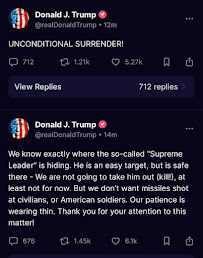
Few minutes back President of USA posted this. I, like billions of common people across the world, don't know what to make of this troubling fast unfolding situation.
WHAT IS GOING ON?
Sunday, June 15, 2025
Alarm calls are getting louder

For last few days I am reading this amazing book that I ordered online (this is the amazing thing about buying online you can get rare and brilliant writers from anywhere in the world within few days –you are no longer in deep pit of Indian mediocre writing. Even a decade back you had to struggle to get a book and eventually give up after making rounds of bookstalls…I recall getting a desperately wanted rare book from South America from a person I randomly met and went out few times!). So here I am into a book that is absolutely besotted to Peregrine Falcon/tiercel (The Peregrine; JA Baker), his obsession to this bird is a unique form of writing –indeed brilliant, that I am yet to encounter (I have read many brilliant Indian writers on birds like Salim Ali, Ranjit Lal, M. Krishnan…so on). This book has since become a classic. Simultaneously I watch the world has become much dangerous as violence escalates to wars. Instability that question entrenched status quo is welcomed, dismantling pan global elite consensus on neoliberal capitalism that is founded on regressive values and nurtured on feudal exploitative structure, the chaos is much needed. Hopefully they churn out something that is reflection of reality and not fiction of unlimited growth. What is alarming is weakening of democratic institutions within nations, as also significantly, the breakdown of diplomatic consensus and restraint among nations. It is a remarkable failure of international community and lack of vision by leaders.
So as I read exquisite details that open up wonders of peregrine hawk I also see distressing videos of escalating war and mayhem while climate catastrophe creates other horror scenes of flooding and heat waves. “For warning…they (peregrine) rely on their remarkably keen hearing and on the alarm calls of other birds”, so the awareness of danger is from two sources, their own acute senses as also connection with reality of the world they live in. There are clear indication that world around us is collapsing, resilience of life giving ecosystem is diminishing, biomass diversity is reducing and species are vanishing. You can observe it by not seeing many species (like insects, birds so on) that you used to see and hear before. You can understand it by using critical faculties and reading extensively on these matters from people who have spent years researching and scientists who studied these minutely and reached a peer reviewed consensus, as also passionate people who have used innovative skills and ways to communicate the urgency of the matter. If you lack this basic sense then you are incapacitated to hear the warning. You also have to investigate the systems that incapacitate humans to hear and see the warning. How have their senses become so blunt, that they are so dehumanized, to use basic faculties? In nature there are two types of species which help humans understand condition of immediate environment. Indicator species like lichens tell us about quality of ecosystem. How people are reacting, responding and compromising with overwhelming systems that controls, tells us about condition of society and how much democratic humanistic concerns are valued. Clearly something is amiss. Sentinel species are the one that tells about dangerous environment, they detect toxic presence like canary in cave. There are prescient people with heightened sensibilities that connect to complexities of reality who keep warning us of the dangers. In an attention seeking economy and overwhelming crass these too are submerged by mediocre who caricature them for gain. Fortunately for humanity these wonderful people are nurtured and valued in evolved societies. They are making all efforts through their presence to warn us. I read them in their writing, hear them in their talks, watch them in their expressions, sense them in their art…the alarm calls are getting louder. If humans have senses even minutely as acute as peregrine falcon they will be alert. If they have any responsibility they will actively demystify and dismantle systems that blunt human sensibilities and negate humanity. Violence is a symptom of deep flaw and natural outlet of deviant systems.
“I saw his colours clearly in the brilliant light: back and secondaries rich burnt sienna; primaries black; underparts ochreous yellow, streaked with arrowheads of tawny brown. Down the pale cheeks the long dark triangles of the moustachial lobes depended from the polished sun-reflecting eyes. Through the smoke, through the spray, he glided over the wall in a smooth outpouring, like water gliding over stone. The wader shimmered to earth, and slept. The hawk’s plumage stained through shadows of smoke, gleamed like mail in glittering spray. He flew out in the grip of the gale, flicking low across the rising tide. He slashed at a floating gull, and would have plucked it from water if it had not flown up at once. He flickered out into the light, a small dark blemish diminishing along the great sword of sun-dazzle that lay across the estuary from south”. Phew, now that is some evocative writing!
Tuesday, June 10, 2025
Uncertain times, entropy, chaos…

As the systems are shaken there
is a general view that we have entered uncertain times! To make it clear world
was always uncertain. Life lives by negotiating edges of ever present chaos. That
is how species evolve by being under constant loop with ever changing reality. Indeed
most human being live with amazing insecurities, negotiating life as it
presents. It is very few who are controlling and negotiating the systems that
find themselves suddenly thrown into chaos. With Trump blasting neoliberal
ecosystem of understanding of Left and Right with his carefully nurtured transactional
world view, add to the uncertainties of climate breakdown, AI, as also herd
getting weaponised through social media thus giving new vigor to atavistic concerns
and juvenile preoccupations of religion. Delicately balanced political correctness
(the consequences of which were delegated to common people) is now collapsed under
woke debris. This stable world that was orchestrated as “progress” was very much
confined to few, ofcourse much of the world is relatively better off thanks to comforts
and conveniences provided by innovative technologies, socialist concerns of
state across most of the world, and egalitarian value system in some societies that
create resilience and social safety net. What is more this growth was hinged on
unlimited supply. This unlimited supply for unlimited neoliberal growth was to
be provided by exploiting earth and people. Clearly life giving ecosystems are collapsing
as also income disparities have increased. Neoliberal capitalism was kept
isolated from reality through wanton exploitations -that created spurts of
material benefits, while morphing these through sophisticated economic jargons of
development and management language of efficiency, and creating incentive to
join the system to be successful –for which religion provided compelling validation.

Friday, June 06, 2025
Redefining framework of discourse
There is a renewed vigorous attempt by devious forces to play savior by controlling vestigial narration into contemporary. Invoking words with loaded meaning from past that has no connection with the realities of present other than keeping their own significance as also estimating and trapping common people as unthinking herd. Words like antisemitism cannot be allowed to be used as if nothing has changed in the world in last many decades. The context of the world we live in 21st century cannot be allowed to be pulled into horrors of past to create narration that has no semblance to people’s reality. These words undermine and dilute the complexities of the world we live in. Religion is not sacred nor is Judaism nor jews (nor criticism of Israel be automatically deemed as criticism of jews). References to Nazi or Hitler shouldn’t be allowed to be reduced as mere antisemitism hence frozen into specific context of history. These are threat to humanity (it is a threat to each and every human), and must be dealt in within the ambit of rule of law. There nothing more to it. This attempt to haul in decomposed baggage of history through sophisticated semantics –these intellectual jargons are meant to obfuscate reality into convenient frame, to establish sterling historicity defining presence. Every attempt to alter reality to fit in concerns of past must be resisted. That doesn’t mean history is not important, its importance is only in understanding and not keeping it alive by extending meanings of words from past. This completely bypasses human understanding and changed realities of present. It is a sinister attempt to undermine human progress and control people as puppets. What has happened in history must be understood and kept away from present; it’s a closed chapter and shouldn’t be allowed to claim anything. Present must be dealt with egalitarian values and stringent rule of law using latest technology. An incapacitated society and a vacant ruing civilization keeps invoking the grandeur or grievance of past. It is meant to keep the herd occupied.
Serious concerns like discrimination must be dealt with tools that sync in with the realities of present. There is an industry functioning that evaluate everything in the light of dead past to replicate and perpetuate horrors of the past. It is a failure of present if history has to be invoked. History only becomes significant, and repeats, when people are reduced to herds, when people are not vigilant and complacent and fall for easy narration of pattern from past. Atrophying religions have strange claims of their myths through history, and are nurtured by left to centralize history to constantly diminish the present. Definition of antisemitism cannot be allowed to frozen in the past and treated as some sort of fragile concept, it will have to face the rigor of the present, and redefined upgraded to meaningful definition of the contemporary or else it is a sinister attempt to replicate past by converting people into herd. Nazi were antisemitic and responsible for genocide of Jews. It is one of the horrifying chapters of human history. The attempt here is not to deny horror of holocaust but to dissociate from dangerous repetitions of past. It is an attempt to reframe framework of discourse so as to not negate the contemporary. Therefore in the contemporary world Nazi salute cannot be seen as antisemitic. It must be seen as a caricature of past that shouldn’t be given the import it craves. It is definitely an assault on humanity as it reminiscence horror of past and an attempt to recreate therefore highly objectionable and must be stringently dealt. The shift from framework of specificity of history, from context and concerns of past, to secular universal relevance and humanist concerns of present is a significant step that must be acknowledged. Invoking the history of genocide against jews as only relevant to jews undermines contemporary humanity and attempts to replicate failure of past. It acts to segregate humans into unthinking compassionless people dictated by fate of history, herds controlled by devious narration controllers. In the contemporary understanding prejudice is directed against a human, and cannot be against religion since religion has factors working which can be fertile source of prejudice which the concerned religion will have to deal and investigate the source of prejudice. Prejudice against a human is against his or her being like gender, skin color so on hence against humanity. A person from any religion is human first, and that concern frames the response.
Religion cannot claim to be discriminated; it is the people who are discriminated not the system. Also beware of the clever attempt to create binary narration for Islamophobia; it has very less to do with realities and context of antisemitism nor can these two religions be equated –it is false equivalence to hide dangers of Islamism. Discrimination must be addressed and dealt with care without normalizing systems of control. As humanity evolves contemporary world should be equipped to explore tribulations of human condition, rather than easy anachronistic fixes and complacent replication of primitive past. We must use our intelligence and be alert against nefarious forces particularly the narcist ones in the cloak of saviors. Meanwhile religion and supremacist values must be constantly reminded of its limitations within rule of law and doesn’t have any special claim whatsoever that undermines human rights and individual freedom and liberty. A thriving humanity will have healthy religiophobia and will resist feudal systems of control. It will have humanist rule of law and empathy driven aesthetic expressions. Critical cases will have to be dealt on case by case basis rather than swept in flourish of narration and attached to broader pattern to create superstructure of concerns. Contemporary world is too complex and connected to have sweeping patterns.
Systems that nurture history to define contemporary must be deconstructed and resisted with full force of humanity as it thrives on dehumanizing contexts. History provides rather minor understanding of present (it is not a guiding force), more of unique context of past, and a significant realization of threat that it carries if replicated. Humanity will have to make all attempts to dissociate from pull of the past –replication can only happen if complexities of present are negated. Present is the best possibility of human history. It has to be understood, cherished, and valued to deal with increasing complexities of future.
Rabid frothing of neoliberal muck

The most “powerful man” in the world (as defined and nurtured by neoliberal value system) and the most “richest man” in the world (as defined and nurtured by neoliberal value system) are going for each other’s jugular. The ramification is exponential to what is happening on regular basis across the world. These are worst people sorted by the system to ace itself as a self justification, they reflect the crass system. Juxtapose this with degrading of atmosphere and polluting of river, land, air, water, silence and darkness, ensuing breakdown of climate and biodiversity loss, also lack of trust in insular media, the astounding lack of responsibility. These are very much the byproduct of transactional value system, a general lack of self awareness and existential humility. The crass is reaching a critical point, the rabid frothing of neoliberal muck is hitting the roof. As climate breakdown accelerates crude ego maniacal humans are in muck fight, the system has made them ineffective to have even basic sense. Self preservation of the system is at the expense of life on planet.
For last many decades every transaction is valued on profit (or power accrued which pave way to greed), success in these anchored meanings of deal, fantastical views of religion synced to create world of debauchery, a compelling exceptionalism and supremacist presence. These encroach institutions as extraction including education (classified as human resource) and nature (classified as natural resource) attuned to greed, acquisition and ease of consumption. Words like progress and development were redefined on the parameter of neoliberal capitalism and its egomaniacal assuredness. They undermined democratic institutions, transgressed ethics, nurtured feudal regressive values and enthused hunter gatherer juvenile mindsets.
Friday, May 30, 2025
Swaying hands, swaying branches
“If you analyse a molecule of chlorophyll, what you get is one hundred thirty six atoms of hydrogen, carbon, oxygen and nitrogen arranged in an exact and complex relationship around a central ring. At the ring’s centre is a single atom of magnesium. Now: if you remove the atom of magnesium and in its exact place put an atom of iron, you get a molecule of haemoglobin. The iron atom combines with all the other atoms to make red blood…” (Annie Dillard Pilgrim in Tinder Creek –what a wonderful book!)
A fortunate quirk
of nature
An unseen
hand
Slice magnesium
atom and swap with iron atom
Slice iron
atom and swap with magnesium atom
Chlorophyll fills
my veins
Blood fill chloroplast
The tree
becomes me
I become the
tree
While hydrogen,
carbon, oxygen, nitrogen, dance unaware
Swaying
hands, swaying branches
Subscribe to:
Posts (Atom)